Embolisation for Adhesive Capsulitis (Frozen Shoulder)
An innovative, minimally invasive treatment to relieve frozen shoulder. A modern interventional radiology technique to restore mobility and reduce pain.
Looking for answers based on your symptoms?
Read our patient guide: Frozen shoulder, pain at nightWhat Is Adhesive Capsulitis, or Frozen Shoulder?
Adhesive capsulitis is inflammation of the shoulder joint capsule, the fibrous envelope surrounding the joint. It causes progressive stiffness, as if your shoulder is literally "freezing". Unlike simple tendinitis, this condition evolves in distinct phases:
- Painful (freezing) phase: Intense pain, especially at night, sometimes extending to the arm.
- Stiffness phase: Maximum limitation of movement, making it difficult to raise the arm or rotate it.
- Thawing phase: Spontaneous improvement, but this can take up to 2 years without appropriate treatment.
This condition mainly affects women aged 40 to 60, people with diabetes, or those who are inactive after trauma. Without intervention, it can impact daily life: difficulty dressing, driving, or even sleeping. Early diagnosis is therefore essential for effective treatment.
Frozen Shoulder Symptoms: How to Recognise Them
If your shoulder is causing pain, here are the warning signs of adhesive capsulitis:
- Constant pain: A dull discomfort that worsens at night or at rest.
- Joint stiffness: Unable to raise the arm above the head or place it behind the back.
- Loss of mobility: Rotations and abduction movements become difficult.
- Muscle fatigue: The shoulder feels "heavy" and weak.
These symptoms often appear insidiously and worsen over several weeks. If this sounds familiar, consult a physician for evaluation. A simple clinical examination, supplemented by MRI or ultrasound, will confirm the diagnosis and guide you towards appropriate interventional radiology treatment.
Conventional Treatments for Adhesive Capsulitis
Before considering embolisation, conservative approaches are often tried:
- Medications: Anti-inflammatories (ibuprofen) and analgesics to relieve pain.
- Physiotherapy: Gentle exercises to stretch the capsule and restore mobility.
- Injections: Corticosteroid injection directly into the joint to reduce local inflammation.
- Physical therapies: Ultrasound or shock waves to stimulate healing.
These methods work for 70-80% of patients, but if they fail – after 3 to 6 months of treatment – a more targeted option is needed. This is where embolisation for adhesive capsulitis comes in, a cutting-edge interventional radiology technique.
Embolisation: A Minimally Invasive Solution for Frozen Shoulder
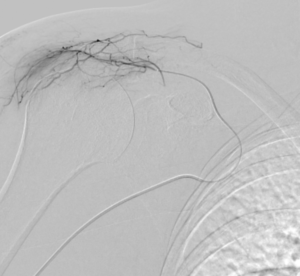
Embolisation for adhesive capsulitis is a recent innovation that targets the root cause of inflammation: hypervascularisation. In frozen shoulder, small abnormal arteries develop around the capsule, fuelling the inflammatory process and pain.
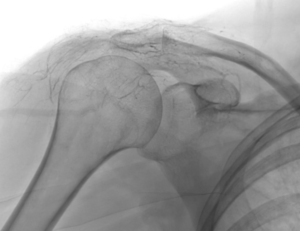
Using precision imaging (angiography), the interventional radiologist identifies these "abnormal" vessels and selectively occludes them. By blocking their blood flow, oxygen and nutrient supply to the inflamed area is reduced, promoting rapid resolution of symptoms.
Benefits of This Treatment
Proven efficacy
Studies show a 70-90% reduction in pain within the first few weeks, with improved mobility in 1-3 months.
Minimally invasive
No surgical incision, just a small arterial puncture.
Outpatient
You go home the same day, with a quick return to activities.
Personalised
Suited to refractory cases, avoiding major surgery such as arthroscopy.
Low risk
Rare complications (less than 2%), such as minor haematoma.
Compared to traditional treatments, embolisation offers more lasting relief, ideal for active patients who do not want to wait months.
Procedure for Adhesive Capsulitis Embolisation
Before the procedure
- Preliminary consultation: Meeting with the radiologist to assess your case via MRI and discuss benefits/risks.
On the day
Duration: 45-60 minutes, under local anaesthesia and sedation if needed.

- Vascular access: A fine catheter is placed without incision in the radial artery on the affected side.
- Image guidance: The catheter is advanced to the subclavian artery under real-time fluoroscopic control.
- Targeted injection: Lipiodol diluted in iodinated contrast agent is injected to occlude pathological arteries.
- Verification: Control angiography to confirm success.
After the procedure
- Short rest: 2-4 hours in the recovery area.
- Follow-up: Physiotherapy recommended from the following week; check-up appointment at 2 months.
- Recovery: Light activities the next day, sport after 2 weeks.
Most patients notice an immediate reduction in night-time pain.
Who Is a Candidate for Embolisation for Frozen Shoulder?
This treatment is ideal if:
- You have imaging-confirmed adhesive capsulitis.
- Medical treatments have failed after 3 months.
- You wish to avoid surgery.
- Your general condition allows an outpatient procedure.
Rare contraindications: severe coagulation disorders or active infection. A personalised assessment by our interventional radiology team will determine whether this treatment is suitable for you.
Ready to book an appointment?
Contact us to discuss your situation and schedule your consultation
Book an appointment