Intradiscal Injection
A safe and effective minimally invasive technique to treat pain related to discopathy and Modic 1 inflammatory changes. Performed under precise radiological guidance by an expert team.
What is discopathy?
This is a term very frequently found in X-ray, CT, and MRI reports. It is a source of concern for patients, yet it is a normal aging mechanism found in everyone, like wrinkles!
It is actually wear of the disc, which can be compared to a sponge that loses its elastic properties and collapses.
This physiological phenomenon begins around age 20–30 and continues throughout life, more or less significantly depending on occupation and sports activity.
Discopathy in the strict sense is not responsible for symptoms. It must be differentiated from disc herniation and other causes of pain, particularly Modic 1.
What is Modic 1 inflammatory change?
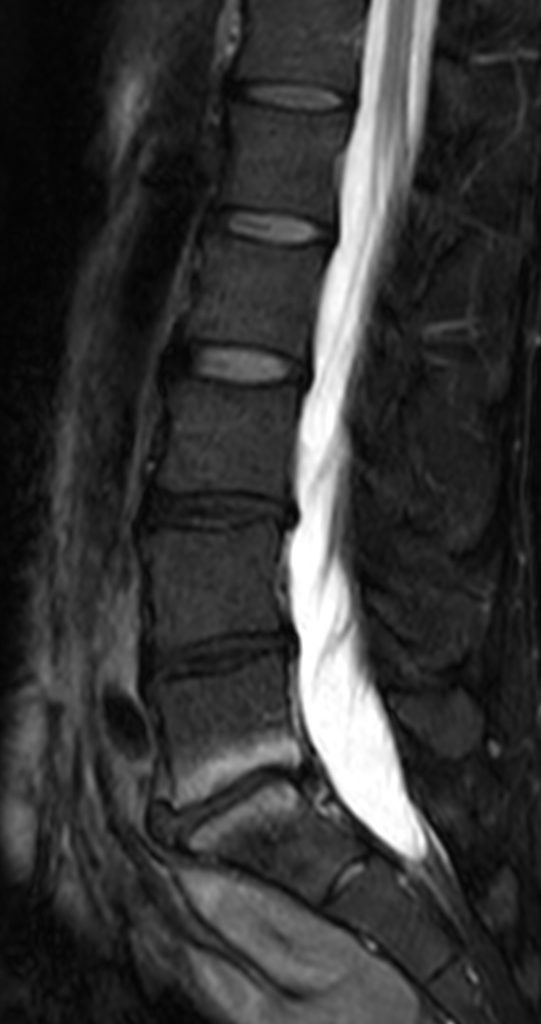
Modic refers to a physician who developed a classification published in the late 1980s. This classification describes MRI signal abnormalities of vertebral bodies secondary to discopathy.
Modic 1 corresponds to inflammatory and therefore painful changes of vertebral endplates. Again, it is not discopathy itself that causes pain, but it is the origin of Modic changes.
The more extensive Modic 1 changes are in the vertebral bodies, the more significant the pain.
Modic 2 corresponds to fatty changes of vertebral bodies. In musculoskeletal pathology, the presence of fat reflects healing phenomena.
The natural history of symptomatic Modic 1 is to evolve toward asymptomatic Modic 2. The problem is that this mechanism is very long, averaging 2 to 3 years, hence the need to find solutions for patient pain.
Characteristics of Modic 1 pain
This condition mainly affects younger adults around age 40, causing work absenteeism and especially psychological consequences (poor sleep, irritability, reduced sports activity, depression, etc.).
Modic 1 pain is common low back pain with the following characteristics:
- Chronic evolution (>3 months)
- Predominant lower lumbar pain, sometimes associated with radicular pain, i.e., painful pathways in the buttocks and legs, more marked on one side than the other
- Inflammatory pain: nighttime awakening when changing position and morning stiffness with gradual improvement during the day
Principle of intradiscal injection
Intradiscal injection consists of introducing a very fine needle into the central part of the pathological disc, where inflammation is most significant on MRI, to deliver a corticosteroid (hydrocortisone acetate) with anti-inflammatory action.

How is the procedure performed in practice?
We perform this procedure during a short outpatient hospitalization (half a day). Please remember to bring the injection product (hydrocortisone acetate).
The procedure is performed under anesthetic sedation (conscious sedation without intubation) or local anesthesia. Anesthetic sedation is recommended for patients with apprehension or stress about the procedure.
For the procedure, the patient is positioned on their stomach. If this position is uncomfortable, it is preferable to perform the procedure under anesthetic sedation. Local anesthesia of the skin and tract is performed to place a needle under fluoroscopic guidance into the central part of the disc.
Once in place, an initial contrast injection confirms positioning and ensures absence of vascular opacification that would contraindicate injection of particulate corticosteroids.
If opacification is satisfactory, 2 ml or less of hydrocortisone acetate is injected into the disc.
A dressing is applied and the patient returns to the outpatient unit for brief monitoring before discharge home (accompaniment mandatory if anesthetic sedation was used).
Expected benefits
Partial or complete pain disappearance allowing gradual return to activities, physiotherapy, and psychological well-being
However, the duration of effect is difficult to estimate and highly patient-dependent, ranging from a few weeks to several months
If pain recurs, a new injection can be offered (theoretically 3 injections per year)
Confirming the origin of pain: if the injection is effective even temporarily, this is important information for the surgeon who will have more arguments to propose surgery. This is called a diagnostic test
Risks and complications
Risks common to all injections:
- Hemorrhagic risk: rare due to the small caliber of needles used. It is important to mention any antiplatelet or anticoagulant medication.
- Infectious risk: also rare. The procedure is performed under aseptic conditions in the operating suite. Antibiotic prophylaxis is not recommended for this procedure.
- Neurological risk: exceptional risk. Particulate corticosteroids (hydrocortisone acetate) must not be injected into blood vessels due to the risk of thrombosis and ischemia depending on the vessel affected. This is why a preliminary opacification step is performed to ensure absence of vascular contamination.
Risk specific to intradiscal injection:
- Iatrogenic spinal nerve puncture: the needle tract passes a few millimeters from the spinal nerve. If pain like an electric shock occurs in the leg, it is important to notify the physician during the procedure to correctly reposition the needle. This pain is brief and transient.
Post-procedure recovery
Relative rest is recommended for 48 hours. This means the patient can get up and move around but should not plan long car trips or sustained activity.
Pain may worsen initially but generally subsides after 48 hours.
The beneficial effect of the injection may be delayed up to 7 days, so patience is required.
Frequently asked questions
What are the different available treatments?
First-line treatment: Medication management with analgesics, anti-inflammatories, and short-course corticotherapy, combined with physiotherapy.
Second-line treatment: Spinal injections. Several types exist: epidural, foraminal, facet joint, and intradiscal. These injections must be performed under radiological guidance (CT, fluoroscopy) for very precise needle positioning. For Modic 1, intradiscal injection is the most effective.
Third-line treatment: Surgery with two techniques: spinal fusion or disc prosthesis.
Special case of L5-S1 intradiscal injection?
The L5-S1 disc is technically more difficult to access because it is "embedded" in the pelvis and iliac crests can make approach more difficult. It also has a more marked obliquity than other discs. Nevertheless, we succeed in infiltrating this space in most cases, at the cost of a slightly longer procedure time.
Ready to book an appointment?
Contact us to discuss your situation and schedule your consultation
Book an appointment